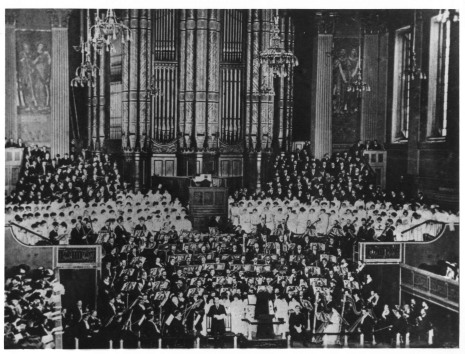
Primera interpretació de The Dream of Gerontius el 3 d'octubre de 1900 en el Birmingham Triennial Music Festival, sota la direcció de Hans Richter
Ja fa quasi bé dos anys que vaig portar a Elgar al blog, en aquella ocasió de la ma de la gran Janet Baker.
Abans d’ahir em va arribar de les immensitats internàutiques “The Dream of Gerontius” en una versió que em va cridar molt l’atenció.
Si haguéssim d’escollir dues de les obres del catàleg imprescindible d’aquest gran músic anglès, estic ben segur que la majoria escollirien les genials Variacions Enigma o el concert per a cello i orquestra i les populars marxes de Pompa i Circumstàncies, però seríem una mica més justos si deixéssim l’engrescadora i grandiloqüent B.S.O. de l’Anglaterra més autènticament tòpica del himne omnipresent, estiu rere estiu, a la folklorista i patriòtica LAST NIGHT dels PROMS i escollíssim The Dream of Gerontius, el inclassificable Oratori que recull les essències musicals i espirituals del corpus elgerià i la que molts consideren la seva obra més important, el “capolavoro” absolut.
El text del Oratori, obra del cardenal John Henry Newman, és una exaltació de la resurrecció, prenent com a referent la mort de Gerontius, un home senzill i piadós i el viatge que la seva ànima fa fins arribar a Déu, tot passant pel “discutit” Purgatori, on un àngel el vetllarà.
L’obra es va escriure durant l’any 1899 i es va estrenar a Birmingham el 3 d’octubre de 1900, sota la direcció del prestigiós Hans Richter, obtenint una acollida desfavorable, degut a factors d’una certa intransigència religiosa fonamentalista i al llenguatge musical renovador basat en la revolució wagneriana.
La societat anglesa és bàsicament anglicana i Elgar (catòlic) amb aquesta obra toca el moll de l’os de l’essència catòlica amb un Purgatori inacceptable per les creences de l’església oficialista que varen arribar a exigir fins i tot, canvis al llibret.
Pel que fa a la música, potser encara era massa aviat per que l’Anglaterra més tradicionalista acceptés un llenguatge que no amagava l’admiració cap a Wagner i el seu Parsifal en particular, amb un desplegament de mitjans orquestrals i corals al servei d’una obra ambiciosa, que s’allunya dels oratoris tan estimats a Anglaterra, des de Handel a Mendelssohnn, sense oblidar Haydn, amb números aïllats, per esdevenir una obra monumental en dues parts (la segona subdividida en dues) on els esdeveniments es van succeint amb un discurs homogeni i lligat, malgrat les diferents parts que les composen.
Part I:
- Prelude
- Jesu, Maria – I am near to death
- Rouse thee, my fainting soul
- Sanctus fortis, sanctus Deus
- Proficiscere, anima Christiana
Part II:
- I went to sleep
- It is a member of that family
- But hark! upon my sense comes a fierce hubbub
- I see not those false spirits
- But hark! a grand mysterious harmony
- Thy judgement now is near
- I go before my judge
- Softly and gently, dearly-ransomed soul
La primera part ens mostra a un home vell, seré, temorós i esperançat en la resurrecció de la seva ànima, mentre reflexiona en la seva vida i les errades comeses, acompanyat per les pregàries d’un cor d’ajudants que l’acompanyaran fins a la mort i un sacerdot el guiarà per iniciar el camí, en una imatge que ens recorda l’obra pictòrica renaixentista.
A la segona part, subdividida en dues parts, l’ànima de Gerontius es troba en un lloc indeterminat on establirà un diàleg preparatori amb l’Àngel, en el llibret havia de ser interpretat per un home però Elgar va estimar-se més utilitzar a un mezzosoprano, que l’ajudarà a l’encontre amb Déu.
A la part final que conclou la segona part, Gerontius s’haurà d’afrontar amb Déu. L’Àngel, en un pregària final ens anunciarà en una benedicció l’imminent despertar a la Glòria de Déu.
Musicalment l’obra està escrita per a una gran orquestra, doble cor, un semicor i quatre solistes, un tenor, Gerontius, una mezzosoprano, l’Àngel, un baríton per cantar la part del sacerdot i un baix per fer-se càrrec del Àngel de l’Agonia. Normalment con que aquestes dues parts són curtes, les acostuma a cantar un únic solista, un baix-baríton.
L’estil d’Elgar l’haurem de situar al final del període romàntic i sota la influència directa del llegat wagnerià, amb una intensa escriptura d’envolupant lirisme i espiritualitat.
L’obra s’inicia amb un preludi que ens presentarà a manera de leitmotiv, els principals temes de l’obra, com el de la sentència o el colpidor tema de l’oració de Gerontius, acompanyat amb orgue i timbales, fins arribar l’entrada del tenor.
L’estil vocal no és gens afectat,més aviat estem davant d’un recitat melòdic que l’anirà portant per els diferents estats d’ànim, sense emprar recursos melodramàtics.
Les parts corals són d’extrema dificultat i l’orquestra és l’aglutinador que va entrellaçant de manera magistral tots els temes d’una partitura riquíssima, ja sigui melòdicament, com en l’orquestració i les harmonies i polifonies corals.
Les parts solistes són d’una emotivitat intensa, molt interioritzada, sobretot quan intervé l’Àngel a partir de la sensacional entrada en la segona part que ara us deixaré escoltar en la veu de Magdalena Kožená i Toby Spence.
Angel
My work is done,
My task is o’er,
And so I come,
Taking it home,
For the crown is won,
Alleluia,
For evermore.My Father gave
In charge to me
This child of earth
E’en from its birth,
To serve and save,
Alleluia,
And saved is he.This child of clay
To me was given,
To rear and train
By sorrow and pain
In the narrow way,
Alleluia,From earth to heaven.
Soul
It is a member of that family
Of wondrous beings, who, ere the worlds were
made,
Millions of ages back, have stood around
The throne of God:—he never has known sin
But through those cycles all but infinite,
Has had a strong and pure celestial life,
And bore to gaze on the unveil’d face of God,
And drank from the everlasting Fount of truth,
And served Him with a keen ecstatic love.
Hark! he begins again.Angel
O Lord, how wonderful in depth and height,
But most in man, how wonderful Thou art!
With what a love, what soft persuasive might
Victorious o’er the stubborn fleshly heart,
Thy tale complete of saints Thou dost provide,
To fill the thrones which angels lost through pride!He lay a grovelling babe upon the ground,
Polluted in the blood of his first sire,
With his whole essence shatter’d and unsound,
And coil’d around his heart a demon dire,
Which was not of his nature, but had skill
To bind and form his op’ning mind to ill.
Then was I sent from heaven to set right
The balance in his soul of truth and sin,
And I have waged a long relentless fight,
Resolved that death-environ’d spirit to win,
Which from its fallen state, when all was lost,
Had been repurchased at so dread a cost.Oh, what a shifting parti-colour’d scene
Of hope and fear, of triumph and dismay,
Of recklessness and penitence, has been
The history of that dreary, life-long fray!
And oh, the grace to nerve him and to lead,
How patient, prompt, and lavish at his need!O man, strange composite of heaven and earth!
Majesty dwarf’d to baseness! fragrant flower
Running to poisonous seed! and seeming worth
Cloking corruption! weakness mastering power!
Who never art so near to crime and shame,
As when thou hast achieved some deed of name;—How should ethereal natures comprehend
A thing made up of spirit and of clay,
Were we not task’d to nurse it and to tend,
Link’d one to one throughout its mortal day?
More than the Seraph in his height of place,
The Angel-guardian knows and loves the ran-som’d race.
Soul
Now know I surely that I am at length
Out of the body; had I part with earth,
I never could have drunk those accents in,
And not have worshipp’d as a god the voice
That was so musical; but now I am
So whole of heart, so calm, so self-possess’d,
With such a full content, and with a sense
So apprehensive and discriminant,
As no temptation can intoxicate.
Nor have I even terror at the thought
That I am clasp’d by such a saintliness.Angel
All praise to Him, at whose sublime decree
The last are first, the first become the last;
By whom the suppliant prisoner is set free,
By whom proud first-borns from their thrones
are cast;
Who raises Mary to be Queen of heaven,While Lucifer is left, condemn’d and unforgiven.
Soul
I will address him. Mighty one, my Lord,
My Guardian Spirit, all hail!Angel
All hail, my child!
My child and brother, hail! what wouldest thou?Soul
I would have nothing but to speak with thee
For speaking’s sake. I wish to hold with thee
Conscious communion; though I fain would know
A maze of things, were it but meet to ask,
And not a curiousness.Angel
You cannot now
Cherish a wish which ought not to be wish’d.Soul
Then I will speak. I ever had believed
That on the moment when the struggling soul
Quitted its mortal case, forthwith it fell
Under the awful Presence of its God,
There to be judged and sent to its own place.
What lets me now from going to my Lord?Angel
Thou art not let; but with extremest speed
Art hurrying to the Just and Holy Judge:
For scarcely art thou disembodied yet.
Divide a moment, as men measure time,
Into its million-million-millionth part,
Yet even less than that the interval
Since thou didst leave the body; and the priest
Cried “Subvenite,” and they fell to prayer;Nay, scarcely yet have they begun to pray.
For spirits and men by different standards mete
The less and greater in the flow of time.
By sun and moon, primeval ordinances—
By stars which rise and set harmoniously—
By the recurring seasons, and the swing,
This way and that, of the suspended rod
Precise and punctual, men divide the hours,
Equal, continuous, for their common use.
Not so with us in the immaterial world;
But intervals in their succession
Are measured by the living thought alone,
And grow or wane with its intensity.
And time is not a common property;
But what is long is short, and swift is slow,
And near is distant, as received and grasp’d
By this mind and by that, and every one
Is standard of his own chronology.
And memory lacks its natural resting-points
Of years, and centuries, and periods.
It is thy very energy of thoughtWhich keeps thee from thy God.
Soul
Dear Angel, say,
Why have I now no fear at meeting Him?
Along my earthly life, the thought of death
And judgment was to me most terrible.
I had it aye before me, and I saw
The Judge severe e’en in the Crucifix.
Now that the hour is come, my fear is fled;
And at this balance of my destiny,
Now close upon me, I can forward lookWith a serenest joy.
Angel
It is because
Then thou didst fear, that now thou dost not fear,
Thou hast forestall’d the agony, and so
For thee the bitterness of death is past.
Also, because already in thy soul
The judgment is begun. That day of doom,
One and the same for the collected world,—
That solemn consummation for all flesh,
Is, in the case of each, anticipate
Upon his death; and, as the last great day
In the particular judgment is rehearsed,
So now, too, ere thou comest to the Throne,
A presage falls upon thee, as a ray
Straight from the Judge, expressive of thy lot.
That calm and joy uprising in thy soul
Is first-fruit to thee of thy recompense,And heaven begun.
Soul
But hark! upon my sense
Comes a fierce hubbub, which would make me fear
Could I be frighted.Angel
We are now arrived
Close on the judgment-court; that sullen howl
Is from the demons who assemble there.
It is the middle region, where of old
Satan appeared among the sons of God,
To cast his jibes and scoffs at holy Job.
So now his legions throng the vestibule,
Hungry and wild, to claim their property,
And gather souls for hell. Hist to their cry.Soul
How sour and how uncouth a dissonance!
No va ser fins l’estrena alemanya a Düsseldorf el 19 de desembre de 1901 que l’obra assolí l’èxit que es mereix i que no l’ha abandonat mai més. Segurament la societat alemanya estava musicalment més formada o era més receptiva per escoltar aquella música que tant li devia a Richard Wagner.
Va ser a partir de l’acceptació d’aquesta obra, quan el món es va adonar de la importància d’Elgar per a la història de la música, fins aleshores mal acceptat ja fos a l’Anglaterra sempre tancada en si mateixa, com al continent, on mai s’ha tingut en compte la importància de la música provinent de les Illes Britàniques.
Pel que fa a la versió que ha motivitat aquest post, va tenir lloc el dia 6 de desembre de 2009 a la Großer Musikvereinssaal de Viena, amb Sir Simon Rattle (altre cop al blog) dirigint de manera captivadora i extraordinàriament emotiva al capdavant de la plusquamperfecta i luxuriosa Filharmònica de Viena i cors i amb la seva senyora, Magdalena Kožená enlluernant com és habitual en ella, en un fantàstic àngel i el tenor Toby Spence assumint de manera brillant el Gerontius i la seva ànima. La part negativa, i em sap greu dir-ho, és Thomas Quasthoff en un estat vocal més que preocupant, sobretot en la part més baritonal, tot i que tampoc en la part del àngel de l’agonia acaba de trobar la centralitat de l’emissió. Preocupant de veritat i una llàstima, doncs encara que les seves intervencions són curtes, no deixen de pertorbar una versió magnífica.
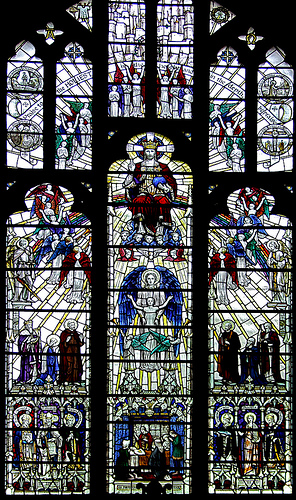
The Dream of Gerontius vitralls a la Worcester Cathedral
Edward Elgar
“The Dream of Gerontius”, Oratorium, op. 38 (94 Min.)
Magdalena Kožená, Mezzosoprano
Toby Spence, Tenor
Thomas Quasthoff, Baix
Singverein der Gesellschaft der Musikfreunde in Wien
Wiener Philharmoniker
Director: Sir Simon Rattle
Großer Musikvereinssaal Viena, 6 de desembre de 2009
Si voleu baixar-vos la versió proposada, premeu:
Si voleu veure el text del oratori, premeu aquí.
M’agrada tant aquesta obra que no em puc estar de deixar-vos l’emocionant final amb Magdalena Kožená i el cor final (sabeu de la meva estima per les parts corals)
Angel
Softly and gently, dearly-ransom’d soul,
In my most loving arms I now enfold thee,
And, o’er the penal waters, as they roll,
I poise thee, and I lower thee, and hold thee.And carefully I dip thee in the lake,
And thou, without a sob or a resistance,
Dost through the flood thy rapid passage take,
Sinking deep, deeper, into the dim distance. {370}Angels, to whom the willing task is given,
Shall tend, and nurse, and lull thee, as thou
liest;
And masses on the earth, and prayers in heaven,
Shall aid thee at the Throne of the Most
Highest.Farewell, but not for ever! brother dear,
Be brave and patient on thy bed of sorrow;
Swiftly shall pass thy night of trial here,
And I will come and wake thee on the morrow.
Espero que us agradi.
Descobriu-ne més des de IN FERNEM LAND
Subscribe to get the latest posts sent to your email.

Gràcies pels links, aquesta és una obra que m’interessa molt. Llàstima el que dius de Quasthoff, però tot i així la gravació pareix excel·lent.
M'agradaM'agrada
gràcies! No coneixia aquesta obra, però com t’agrada tant a tu deu ser meravillosa. La escoltaré amb molt d’atenció 🙂
M'agradaM'agrada
Gràcies Hita per la confiança que em mostres. Estic convençut que t’agradarà.
M'agradaM'agrada